
Can Foreigners Buy Property in Mauritius?
Foreigners can buy property in Mauritius through authorised routes, subject to specific rules. Here is what international buyers should know about ownership, approval, title registration and more.

Updated August 2026
Foreigners can buy property in Mauritius, but not in exactly the same way as Mauritian citizens. Property ownership by non-citizens is regulated, which means that international buyers must use an authorised acquisition route and obtain the required approvals before ownership can be legally transferred.
For many buyers, this framework is actually part of the appeal. Mauritius offers a structured route to property ownership, supported by clear legislation, notarial processes, official deed registration and a banking system used to working with international clients. The key is understanding what is possible, what requires approval and what should be checked before moving forward.
The Legal Framework for Foreign Buyers
Foreign property ownership in Mauritius is governed mainly by the Non-Citizens (Property Restriction) Act. Under this legislation, a non-citizen who wishes to hold, purchase, acquire or dispose of immovable property in Mauritius must obtain the required authorisation unless the transaction falls within a recognised statutory or approved route.
This applies not only to direct ownership, but also to certain indirect interests. For example, shareholding structures may be treated as an interest in Mauritian immovable property where they give a non-citizen a beneficial interest in land or property. This is why proper legal structuring and approval are essential when a foreign buyer intends to purchase through a company, trust or other structure.
In practice, most foreign buyers do not purchase standalone residential property outside the authorised framework. They usually acquire through approved routes such as EDB property schemes, qualifying G+2 apartment acquisitions or other recognised legal pathways.
For a detailed overview of PDS, Smart City, G+2 and IHS, see our article on property investment schemes in Mauritius.
What Types of Property Can Foreigners Buy?
Foreign buyers can acquire property in Mauritius through specific approved routes. These may include residential units in approved developments, qualifying apartments, certain hotel-linked units or other authorised acquisitions, depending on the buyer profile and the property concerned.
The exact route matters because it affects several important points, including:
whether the buyer can obtain full ownership or a long-term leasehold right;
whether the acquisition may support residence-permit eligibility;
whether the property can be rented out;
what approval process applies;
what payment and banking requirements must be followed.
This is why foreign buyers should avoid treating all property acquisitions in Mauritius as identical. A villa in an approved estate, a G+2 apartment, a Smart City residence and a hotel-linked unit may all fall under different rules.
If you are comparing the main regulated routes side by side, our article on Smart City, PDS and G+2 in Mauritius explains how these options differ in practice.
Where rental income is part of the purchase strategy, our article on rental investment in Mauritius explains the main considerations around long-term and short-term letting.
Residence Permit Eligibility
A qualifying residential acquisition of USD 375,000 or more may make a foreign buyer eligible for a residence permit, subject to the rules in force at the time of application. This residence permit is generally linked to ownership of the qualifying property and remains subject to the applicable legal and administrative requirements.
However, not every property purchase automatically creates residence-permit eligibility. The property must fall within an eligible route, and the buyer must meet the required conditions. Where payment is made in a currency other than USD, the applicable exchange-rate methodology should be confirmed for the relevant residence route.
This point should always be checked before signing, especially where the buyer’s long-term plan includes relocation, retirement or family residence in Mauritius.
For a broader view of relocation, daily life and long-term settlement, our article on living in Mauritius as a foreigner explores the practical points buyers often consider beyond the property itself.
How Property Title Is Registered
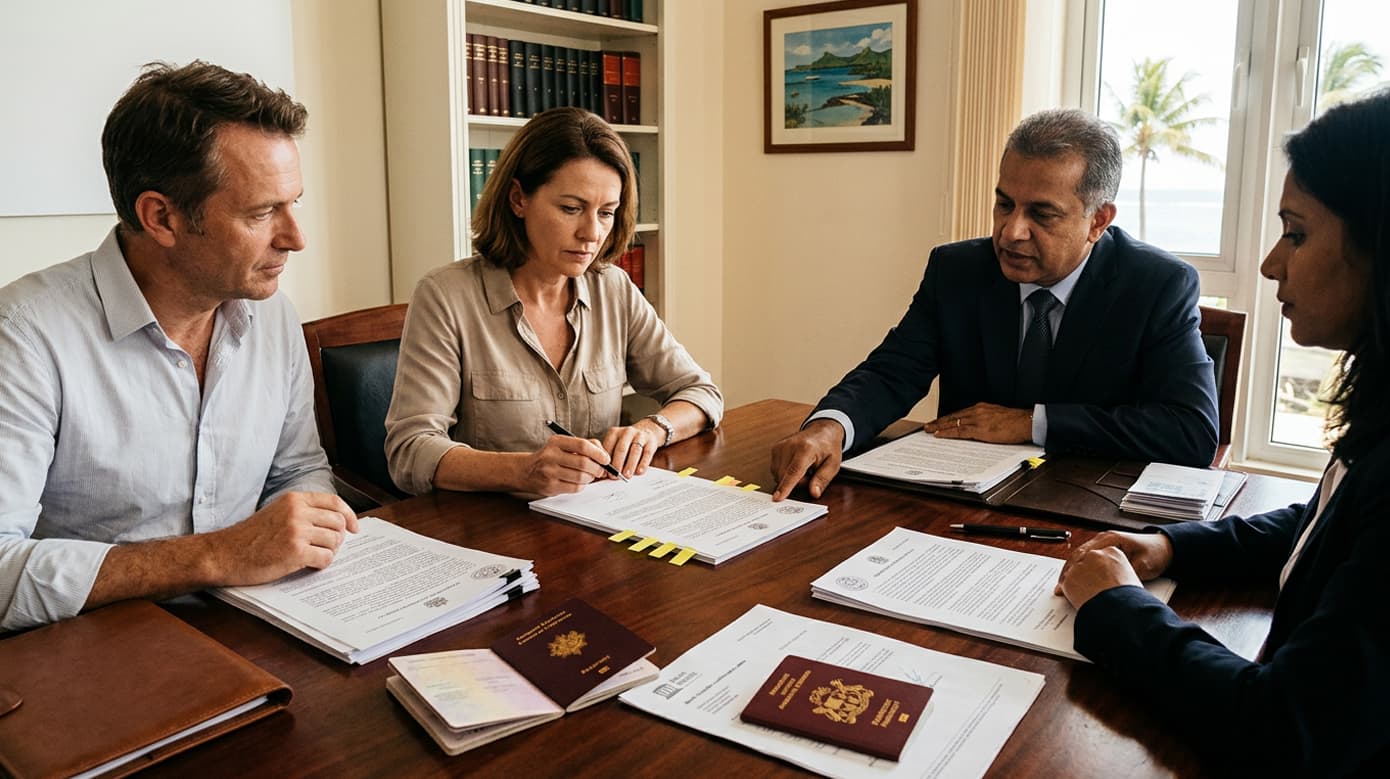
Property transactions in Mauritius are completed through a notary. The notary prepares the deed of sale, carries out the required formalities and ensures that the deed is registered with the Registrar-General.
Once registered, the deed becomes part of the official property record. Mauritius also operates the Mauritius e-Registry, which supports digital access to registered property-related documents.
This official deed-registration framework gives foreign buyers a clear legal structure for recording ownership. However, it should not be confused with a reason to skip due diligence. Buyers should still ensure that proper notarial checks, legal verification and encumbrance searches are completed before acquisition.
Repatriation of Funds
Mauritius does not operate the former exchange-control regime that restricted outward transfers. Exchange control was suspended in 1994, allowing a substantially liberalised framework for international transfers.
This does not mean that funds move without checks. Mauritian banks continue to apply compliance procedures, including KYC, anti-money-laundering controls, source-of-funds verification and supporting-document requirements.
Foreign buyers should therefore keep a clear documentary trail from the beginning of the transaction.
This includes evidence of funds transferred into Mauritius, bank confirmations, notarial records, tax-related documents and sale or rental documentation where relevant.
Payment Mechanics and Banking
Foreign buyers should also be aware of current payment mechanics for certain property acquisitions.
Since the December 2024 amendments, specific payment rules apply to relevant first sales under IRS, RES, IHS, PDS and Smart City Scheme regulations. For transactions falling within those rules, funds are transferred from abroad in hard convertible foreign currency. The notary then ensures that 85% of the purchase price is paid to the promoter in Mauritian rupees, while the remaining 15% may be paid in Mauritian rupees or hard convertible foreign currency.
These rules do not apply to every acquisition by a non-citizen. The Economic Development Board confirms that the amendments concern relevant first sales under the specified schemes and do not apply to resales or to apartment acquisitions under the G+2 route.
The appropriate payment structure should therefore be confirmed for the particular property before funds are transferred.
Opening a bank account as a foreign client is common in Mauritius, but it requires preparation. Banks will usually ask for:
a valid passport or identity document;
recent proof of address;
evidence of source of funds or income;
bank or professional references in some cases;
certified true copies of documents for non-resident onboarding.
Where a company or other structure is involved, additional corporate KYC documentation will generally be required.
Taxes and Transaction Costs
Foreign buyers should verify all transaction costs before signing. Registration duty and land transfer tax are separate charges and fall on different sides of the property transaction.
The Finance Act 2025 had introduced a broader 10% registration duty regime for certain residential property transfers to non-citizens from 1 July 2026, together with broader 10% seller-side land transfer tax treatment.
The Finance Act 2026 subsequently repealed those broader provisions.
Under the current general framework, registration duty is generally 5% on the buyer side and land transfer tax is generally 5% on the seller side, subject to exemptions and specific statutory provisions.
This change should not be understood simply as a reduction from 10% to 5%. The broader special regime introduced in 2025 was repealed.
A separate 10% additional seller-side duty remains in a much narrower situation involving certain residential property situated on State land or Pas Géométriques and transferred to a non-citizen under the relevant apartment acquisition route. This additional duty is payable by the transferor, meaning the seller, and should not be confused with buyer-side registration duty.
Because the treatment depends on the property and transaction, buyers should confirm the applicable duties and costs with their notary before completion.
For a clearer explanation of the current position, read our article on registration duty in Mauritius for foreign buyers.
Frequently Asked Questions
Can foreigners buy property in Mauritius?
Yes. Foreigners can buy property in Mauritius, but they must use an authorised acquisition route and comply with the applicable approval process.
Can foreigners buy any property in Mauritius?
No. Foreign buyers cannot simply acquire any residential property in the same way as Mauritian citizens. Most purchases must take place through an authorised route.
Can buying property in Mauritius lead to a residence permit?
Yes, in certain cases. A qualifying residential acquisition of USD 375,000 or more may support residence-permit eligibility, subject to the rules in force at the time of application.
Can foreign buyers repatriate money from Mauritius?
Yes. Mauritius does not operate the former exchange-control regime, but banks continue to apply standard compliance and source-of-funds checks.
Is property title secure for foreign buyers?
Foreign buyers benefit from the official deed-registration framework used for immovable property in Mauritius. However, legal due diligence and notarial checks remain essential.
Can foreigners buy through a company?
Yes, but indirect ownership and shareholding structures are regulated under the Non-Citizens (Property Restriction) Act. Proper legal advice and the required approval are essential.
What should buyers check before purchasing?
Foreign buyers should confirm the authorised acquisition route, residence-permit eligibility, ownership structure, transaction costs, payment and banking requirements, source-of-funds documentation and resale conditions.
A Structured Route to Property Ownership
Buying property in Mauritius as a foreigner is possible, but it must be approached through the right legal route. The framework is structured, and that structure gives international buyers greater clarity over the acquisition process.
The most important step is not simply choosing a property. It is understanding whether the property is eligible for foreign acquisition, what approval process applies, how the title will be registered, what banking requirements must be met and whether the purchase supports the buyer’s wider plans, including residence, rental income or long-term investment.
The Finance Act 2026 changes also mean that older guidance presenting a broader 10% registration duty and land transfer tax regime as the current rule should no longer be relied upon. At the same time, the separate payment rules introduced in December 2024 continue to apply to the first-sale transactions actually covered by those regulations.
With the right checks in place, Mauritius continues to offer foreign buyers a clear and well-established pathway to property ownership.
Considering a move to Mauritius?
Our team is here to help you discover the finest properties and neighbourhoods that truly match your lifestyle and investment goals.
Explore our developments | Contact our team
Sources
Economic Development Board, Real Estate & Hospitality guidance
Economic Development Board, amendments to IRS, RES, IHS, PDS and Smart City regulations
Economic Development Board, FAQ on amendments to property regulations
The information contained in this article is provided for informational purposes only and reflects the legal and regulatory position reviewed in August 2026. Property acquisition rules, approval procedures, registration duty, land transfer tax, additional duties, residence conditions, payment and financing requirements, banking procedures and regulatory interpretations may change or depend on the circumstances of an individual transaction. Buyers should obtain transaction-specific confirmation from their notary, legal adviser, tax adviser, bank, the Economic Development Board and other relevant Mauritian authorities before making a purchasing or investment decision. Allys and its representatives accept no responsibility for errors, omissions or subsequent regulatory changes.
About the Author